Bac Water Wars
What PTDS Found When Commercial BAC Waters Were Actually Tested

Bacteriostatic water for injection (BAC water) is a sterile diluent comprising 0.9% w/v benzyl alcohol (BA) in water for injection. It’s widely used to reconstitute or dilute injectable drugs and peptides. Although there’s no official reference standard for BAC water, Hospira’s Bacteriostatic Water for Injection, USP is widely regarded as a benchmark product because it is FDA-approved and manufactured under GMP standards.
In 2025, prescription only restrictions and supply shortages increased reliance on grey market and Amazon sourced BAC water. So PTDS commissioned a market survey evaluating commercial BAC waters from Hospira, Lambda, Harmonify, Aqua Sciences, Ocean Pharmaceutical) and additional brands (Lambda, Quality Research, Ocean Pharmaceutical, DNA Labs, Pure Labs, Clear Choice Labs, Generic BAC0129, Aqua Science, Research H20, Peptide Crafters) using %BA, pH, sterility (TAMC/TYMC), endotoxins, heavy metals, TOC, plus a glass vs. plastic comparison and stability testing on expired Hospira vials.
Harmonify and Aqua Science were determined to be identical products (Harmonify = private-label Aqua Science).
Methods
The PTDS survey used several assays:
Benzyl Alcohol (%BA)
Measured by HPLC-UV with external standards. This checks whether the preservative is present at an appropriate level, with around 0.9% expected.
pH
Measured against the expected BAC water range of approximately 4.5–7.
Sterility
TAMC/TYMC growth testing was used to check for viable bacterial, yeast or mould growth.
Endotoxins
USP <85> LAL-based testing was used, reported in EU/mL. The relevant limit used was ≤0.25 EU/mL.
Heavy Metals
No heavy metals were detected, although this was not a particularly useful assay for this type of product.
TOC
TOC was considered not meaningful because benzyl alcohol itself creates a large organic load and overwhelms the signal.
Pass / Fail Criteria
The basic criteria were:
%BA close to 0.9%
pH around 4.5–7
Sterility: no growth
Endotoxin: ≤0.25 EU/mL
Sampling Caveats
The results matter, but they shouldn’t be overstated.
Most products were tested from single vials. Lot age and storage history were not always known. There was no extractables and leachables profiling. Some products were only tested chemically and were not tested for sterility or endotoxins.
So this isn’t a full regulatory evaluation. It’s a market survey showing what was found in the samples tested.
Results: Benzyl Alcohol
Several products had acceptable benzyl alcohol levels:
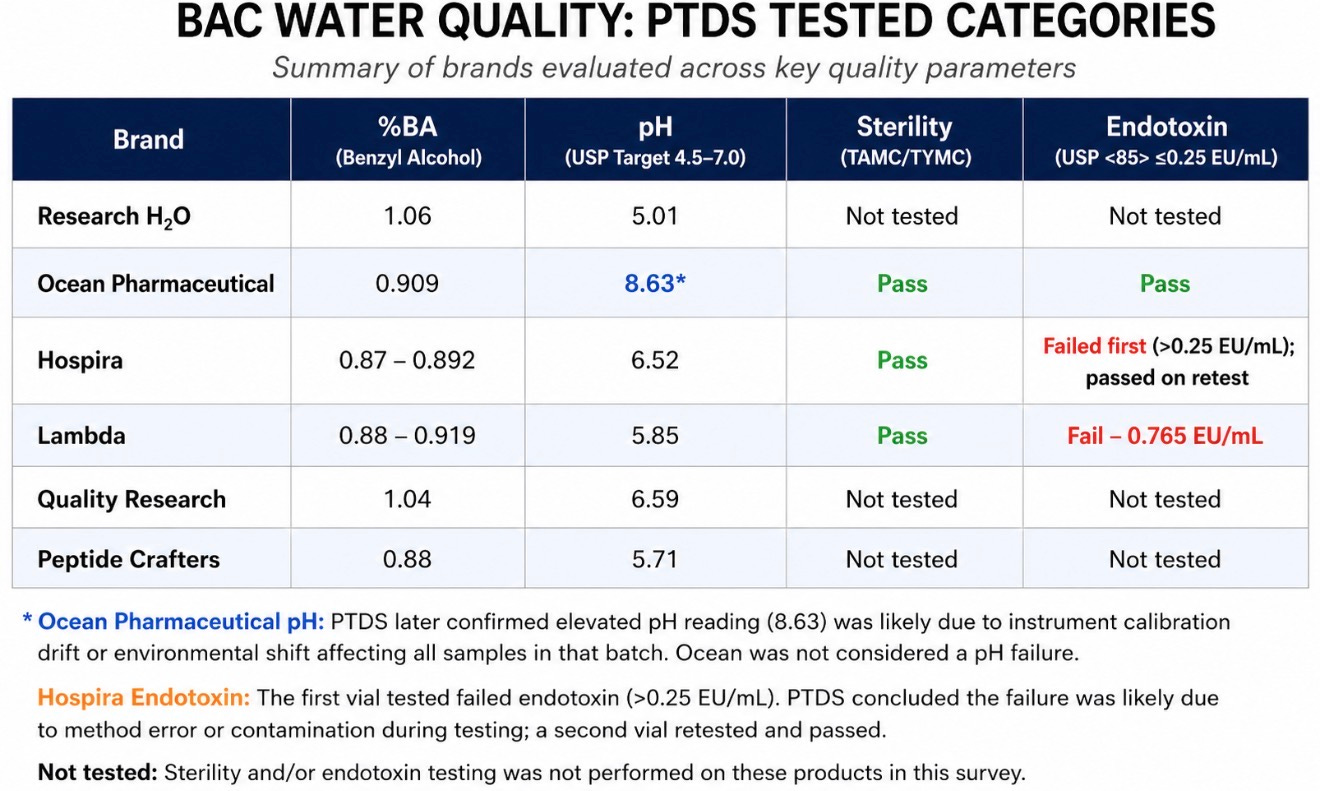
Hospira: 0.87–0.892
Lambda: 0.88–0.919
Research H₂O: 1.06
Quality Research: 1.04
Ocean Pharmaceutical: 0.909
Peptide Crafters: 0.88
Several products failed or raised concerns:
Harmonify: 0.087–0.23
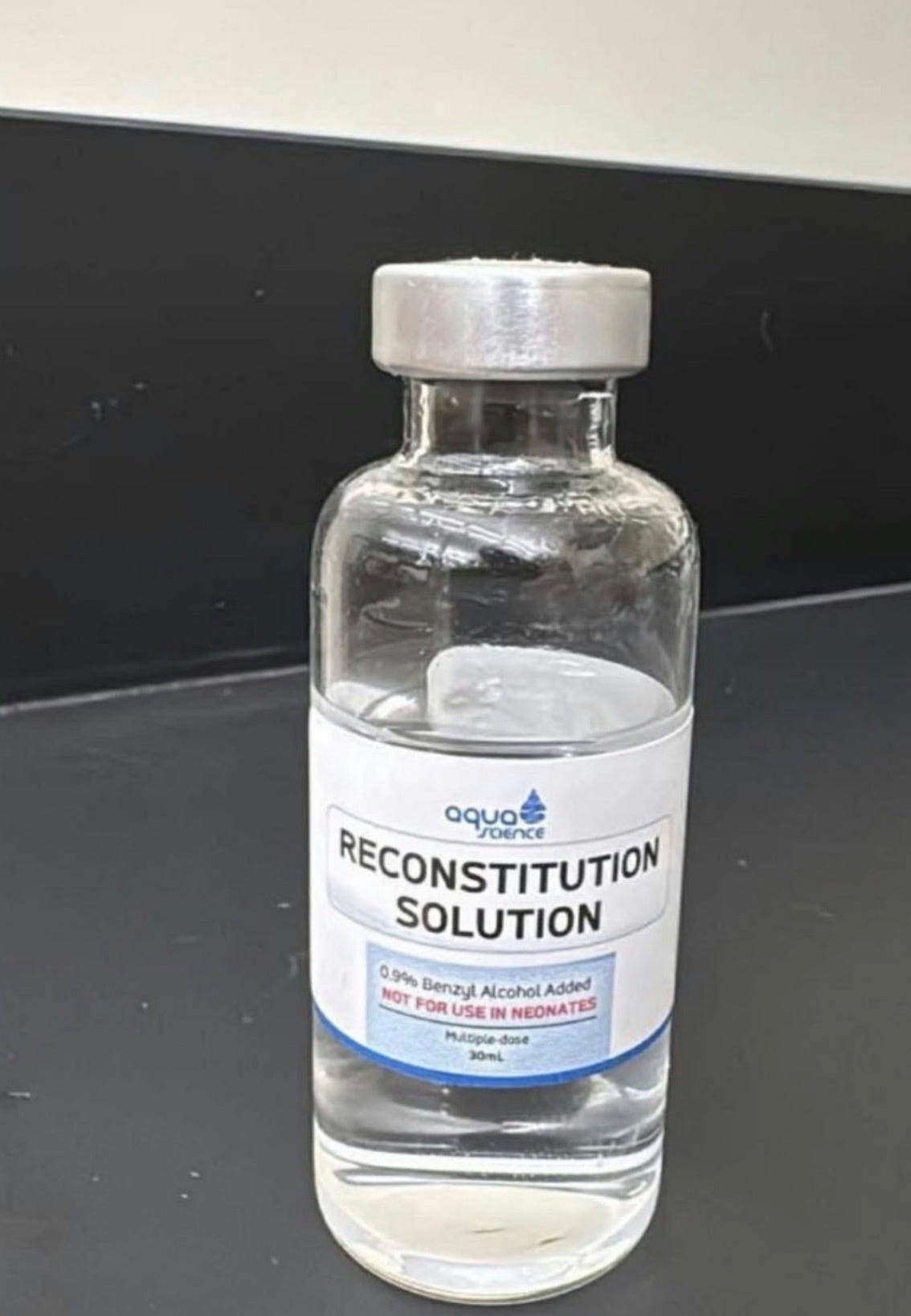
Aqua Science: 0.116–0.11
DNA Labs: 0.12
Pure Labs samples 1 & 2: 0.00
Clear Choice Labs: 1.15
BAC0129: near-spec BA but failed due to extreme alkaline pH
The Pure Labs result is one of the most concerning because it appeared to contain no benzyl alcohol at all. In plain terms, that means it looked more like sterile water being sold as BAC water.
Results: pH
Passing range included Hospira, Lambda, Research H₂O, Quality Research and Peptide Crafters, with reported values around 5.01–6.59.
Generic BAC0129 failed with a pH of 8.84.
Pure Labs was borderline high, around 6.99–7.39.
There was also an important correction: PTDS later confirmed that one batch of pH results was elevated due to instrument calibration drift or environmental shift, affecting samples uniformly. Because of this, Ocean Pharmaceutical was not considered to have failed pH.
Results: Sterility
Products passing sterility included Hospira, Lambda and Ocean Pharmaceutical.
Harmonify and Aqua Science failed sterility.
This matters because sterility failure isn’t a cosmetic issue. It means viable microbial growth was detected.
Results: Endotoxins
Products passing endotoxin testing included Ocean Pharmaceutical and Hospira vial #2.
Failures included:
Harmonify: 5.893 EU/mL
Aqua Science: 5.398 EU/mL
Lambda: 0.765 EU/mL
Hospira vial #1: 5.013 EU/mL
The Hospira failure was later considered a likely method error after repeat testing passed.
BAC Water Quality; Brand Performance Overview
Key Findings
Several brands met chemical criteria, but few met microbiological/pyrogen criteria.
Harmonify/Aqua Science = same source, consistently failed.
Pure Labs contained 0% BA (mislabelled product).
Hospira stable but had one initial endotoxin failure.
Hospira and Ocean Pharmaceutical were the only fully compliant entries
Glass vs Plastic: Lab1x
PTDS also compared Lab1x glass and plastic samples.
Glass showed pH 8.36–8.62 and BA 10.95–14.03 mg/mL.
Plastic showed pH 7.45–8.29 and BA 9.31–10.79 mg/mL.
The differences were attributed to batch inconsistency rather than container material.
The Expired Hospira Test
One of the more unusual parts of the PTDS project involved testing Hospira bacteriostatic water that had been expired for approximately ten years.
Conventional wisdom would suggest that the benzyl alcohol preservative would degrade substantially over that period. The results told a different story.
Testing found that the expired Hospira vials retained benzyl alcohol concentrations within approximately 4.4–5.6% of label claim, while a one-year expired vial measured approximately 1.7% below label claim and an unexpired vial measured approximately 1.8% below label claim.
Stability Study on Expired Hospira Bacteriostatic Water (1/11/2023), specifically measuring the Benzyl Alcohol (BA) Concentration over 120 days
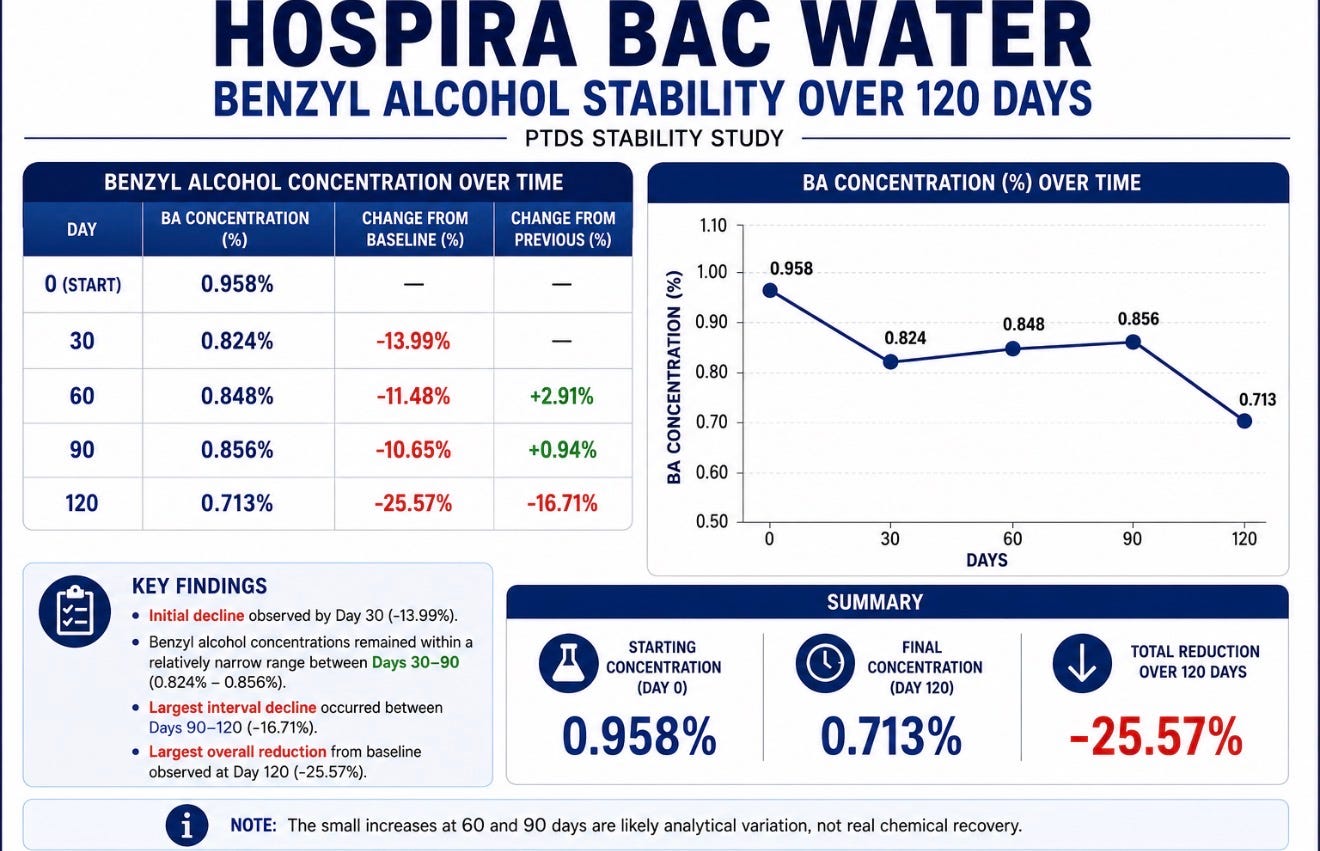
At baseline, benzyl alcohol was around 0.958%.
At 30 days, it dropped to 0.824%.
At 60 days, it measured 0.848%.
At 90 days, it measured 0.856%.
At 120 days, it dropped to 0.713%.
The small increases at 60 and 90 days were likely analytical variation, not real chemical recovery.
The practical takeaway was that Hospira remained fairly stable for 0-90 days, but by 120 days the benzyl alcohol level had noticeably declined to around 0.71%, roughly a 25% reduction from baseline.
Why TOC & Metals Are Not Useful
TOC measures trace organic contamination in organic-free water systems; BA itself overwhelms the signal (~9,000 mg/L carbon).
Heavy metals are implausible in WFI + BA and were absent.
Conclusion
The PTDS market survey revealed substantial variability in the quality of commercially supplied bacteriostatic water. Among all brands tested, only Hospira and Ocean Pharmaceutical were evaluated across all key USP criteria; benzyl alcohol concentration, pH, sterility (TAMC/TYMC), and endotoxins, and were found to be acceptable overall.
Hospira showed one anomalous endotoxin failure (5.013 EU/mL) that passed on repeat testing.
Ocean Pharmaceutical passed all assays performed.
Several brands; Research H₂O, Quality Research, and Peptide Crafters met USP expectations for chemical parameters only (%BA and pH) but were not tested for sterility or endotoxins in the PTDS dataset.
While their preservative strength and pH were compliant, their microbiological and pyrogen safety cannot be determined from available data
Lambda Water passed %BA, pH, and sterility, but failed endotoxin testing (0.765 EU/mL, > USP ≤0.25 EU/mL)
This shows that even chemically acceptable formulations can still pose pyrogen risk.
In contrast, several brands showed critical failures:
Harmonify and Aqua Science (same manufacturer) had severely under-strength BA (0.087–0.23%), failed sterility, and had very high endotoxin levels (>5 EU/mL).
DNA Labs and Clear Choice showed unacceptable BA concentrations (too low or excessive).
Generic BAC0129 had near-spec BA (0.86%) but extremely alkaline pH (8.84) outside USP limits.
Pure Labs contained 0.00% benzyl alcohol, meaning the product was chemically equivalent to sterile water for injection (SWFI) despite being sold as BAC water, indicating mislabelling or formulation failure
Aqua science bac water has failed endotoxin levels again. It was tested by Aminos Analytics and is 0.7 EU/mL